
Central to the operation of the French power system
Balancing supply and demand
The electricity system must remain physically balanced at all times between injections and withdrawals. The electricity market plays a central role in the proper functioning of this system by optimizing the use of generation assets and electricity interconnections at the European level.
Electricity injected into the French grid comes:
- approximately 95% from generation facilities;
- from imports from other European countries.
Electricity withdrawn from the French grid is used:
- for more than 75% for final consumption;
- for exports.
Part of the electricity is used for pumping, and another part is lost during electricity transmission.
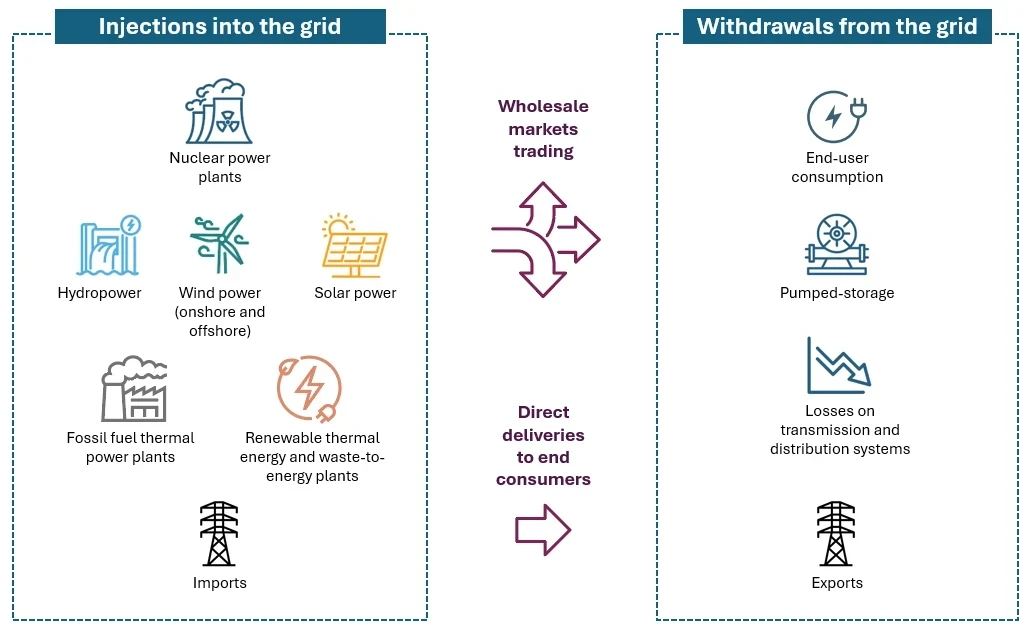
Part of the electricity injected into the grid is not traded on markets: it is directly supplied to final customers by integrated companies, i.e. companies that are both producers and suppliers.
The remainder of production or supply is traded on wholesale markets, resulting in transactions that may lead to physical nominations.
Market participants
The participants operating on the wholesale market are:
- electricity producers, who negotiate and sell the output of their power plants;
- electricity suppliers, who negotiate and procure electricity and then sell it to final customers for consumption;
- traders, who buy in order to resell (or vice versa) and thereby enhance market liquidity;
- demand response operators, who monetize the avoided consumption of their customers.
Trading
Transactions may be carried out:
- on exchanges;
- through brokered over-the-counter (OTC) trading;
- directly over the counter (pure bilateral trading).
Transactions may involve financially settled contracts (derivative products based on the day-ahead electricity price and involving only financial settlement between counterparties) or may result in physical delivery on the French grid.
Wholesale market products: spot or forward
On the wholesale electricity market, two types of products are distinguished: spot products or cash products, relating especially to pan-European day-ahead and intraday market coupling mechanisms (with products purchased for delivery the next day or the same day), and forward products (purchased for delivery during a specified future period).
Spot products
Spot products include:
- for the day-ahead timeframe, 60-minute, 30-minute, or 15-minute products (15-minute products were introduced on the day-ahead market on 1 October 2025). These are traded through a single daily auction covering the entire following day. They may be linked through complex products called “blocks” in order to better represent generation fleet constraints;
- for the intraday timeframe:
- 15-minute, 30-minute, 60-minute products and multi-hour blocks may be traded on a continuous market;
- 15-minute products may be traded during three intraday auctions.
In France, these products are mainly traded on exchanges.
The benchmark prices for the French electricity market are the day-ahead prices calculated by the Nominated Electricity Market Operators (NEMOs) operating in France within the framework of day-ahead market coupling. They are set every day before 1:00 p.m. through a common auction mechanism and are traded the day before delivery, they reflect the supply-demand balance for that timeframe.
NEMOs also operate continuous markets which, until one hour before the start of delivery, are connected through Single Intraday Coupling (SIDC). This system enables real-time pooling of order books between different countries and NEMOs, within the limits of the transmission capacities actually available in real time. After cross-border trading closes, trading remains possible on local continuous markets until delivery. Thereafter, RTE, the French electricity transmission system operator, ensures real-time supply-demand balancing.
In addition, since June 2024, three intraday auctions (IDA) have been implemented:
- IDA 1: open for trading until 3:00 p.m. on D-1 for electricity delivery from 0:00 to 24:00;
- IDA 2: open for trading until 10:00 p.m. on D-1 for electricity delivery from 0:00 to 24:00;
- IDA 3: open for trading until 10:00 a.m. on D day for electricity delivery from 12:00 to 24:00.
These auctions operate similarly to the day-ahead auction. They allow prices for cross-border transmission capacity to emerge and provide an appropriate price signal as close as possible to delivery.
These short-term prices are volatile because electricity cannot be stored on a large scale and factors affecting the supply-demand balance may vary considerably, such as weather conditions (impacting renewable generation, etc.) or unforeseen events affecting the power system (plant outages, reduced interconnection capacity, etc.).
Futures and forwards
Electricity market participants may conclude contracts for sale or purchase of electricity for delivery in the coming days, weeks, months, quarters, or years, at a price negotiated when the contract is concluded.
Futures contracts are exchange-traded forward contracts based on standardized products to facilitate trading, for example delivery of 1 MW of baseload electricity (during all hours of a period), or peakload electricity (from 8 a.m. to 8 p.m. Monday to Friday). Forward contracts are bilateral contracts concluded directly or through an intermediary, with greater flexibility regarding delivery periods and other conditions.
Given their longer horizon and because they generally correspond to the anticipated average spot prices over a given period, forward prices are usually less volatile than spot prices. They are notably used for risk hedging by suppliers and producers and generally serve as the basis for pricing offered to final customers. A supplier entering into a contract with a customer generally hedges most of the deliveries it will have to make by taking into account its generation assets and purchasing the necessary forward products.
Figures published by CRE
CRE regularly publishes analyses on the evolution of electricity, natural gas and CO2 wholesale markets in:
- its annual report on the monitoring and functioning of wholesale markets;
- its quarterly bulletins on wholesale electricity market activity.
The capacity guarantees market
Articles L. 335-1 et seq. of the Energy Code established a capacity obligation mechanism. Each supplier is required to obtain sufficient capacity guarantees to cover the consumption of all of their customers during periods of peak national demand. This mechanism gives market participants incentives to develop demand side management capacities.
Capacity guarantees can be obtained by investing in generating facilities or DSM capabilities, or from capacity operators. RTE guarantees that these operators’ capacities will be available during periods of tightness in the power system.
After capacities have actually been delivered, financial incentives are paid at the end of the year to ensure that the various parties concerned fulfil their commitments and obligations. A secondary capacity guarantee market is organised through EPEX SPOT. The first auction of this kind took place in December 2016.
As required by Articles R. 335-48 and R. 335-51 of the Energy Code, CRE publishes the administered price and the market reference price identified in the capacity mechanism rules, for each year of delivery:
- The administered price for the years 2017 to 2020 was published by CRE in its Deliberation of 1 December 2016 deciding on the rules for calculating the reference price at the administered price as provided for by the capacity mechanism rules;
- The administered price for the years 2021 and 2022 was published by CRE in its Deliberation of 18 December approving the cap price used for the financial settlement of differences in the capacity mechanism for years 2021 and 2022
- The administered price for the years 2023 and 2024 was published by CRE in its Deliberation of 16 December 2021 approving the cap price used for the financial settlement of differences in the capacity mechanism for years 2023 and 2024
- The administered price for the years 2025 and 2026 was published by CRE in its Deliberation of 28 September 2023 approving the cap price used for the financial settlement of differences in the capacity mechanism for years 2025 and 2026
| Year of delivery | Administered price (€/MW) |
|---|---|
| 2017 | 20 000 |
| 2018 | 40 000 |
| 2019 | 40 000 |
| 2020 | 60 000 |
| 2021 | 60 000 |
| 2022 | 60 000 |
| 2023 | 60 000 |
| 2024 | 60 000 |
| 2025 | 60 000 |
| 2026 (january-march) | 44 000 |
The reference price for capacity differences, known as "PREC", is determined in accordance with the methodology defined by CRE in its decision of February 28, 2019 on the methods for calculating the reference price for calculating differences within the the capacity mechanism.
| Year of delivery | reference price "PREC" (€/MW) |
|---|---|
| 2017 | 9999,8 |
| 2018 | 9342,7 |
| 2019 | 17365,3 |
| 2020 | 16583,9 |
| 2021 | 39095,4 |
| 2022 | 23899,9 |
| 2023 | 60000 |
| 2024 | 6200,2 |
- The market reference price is determined by applying the method laid down by CRE in its the years 2017 to 2020 was published by CRE in its Deliberation of 1 December 2016 deciding on the rules for calculating the reference price as provided for by the capacity mechanism rules;
| Year of delivery | Market reference price (€/MW) |
|---|---|
| 2017 | 9999,8 |
| 2018 | 9342,7 |
| 2019 | 17365,3 |
| 2020 | 19458,3 |
For more information on the functioning of the capacity mechanism, see the order of 29 November 2016 defining the capacity mechanism rules, issued in application of Article R. 335-2 of the French Energy Code.