
The wholesale gas market covers both import contracts from foreign countries and trading of gas already physically present on the French network.
Organization of trading
Market participants
Participants operating in the wholesale gas market are:
- natural gas suppliers, who negotiate and procure gas and then sell it to end customers for consumption;
- traders, who buy to resell (or vice versa) and thereby enhance market liquidity;
- transmission system operators, who may intervene on the markets to cover their own needs, ensure system balancing, and manage congestion, as well as storage operators;
- certain industrial consumers, who procure directly on the wholesale market without going through a supplier.
Trading
Transactions may be carried out:
- on exchanges (such as EEX or ICE Endex);
- through brokered over the counter (OTC) trading;
- directly over the counter (pure bilateral trading).
On the French market, almost all traded contracts result in physical delivery of the corresponding natural gas volumes on the network. However, some transactions are purely financial, meaning that the product only results in a financial settlement between the parties.
Most gas pipeline imports from foreign countries are negotiated OTC directly between the parties. These contracts generally run over long periods (20 or 30 years). They allow buyers to secure their supplies and producers to secure outlets over a sufficiently long period to invest in exploration, production, and transportation activities with long amortization periods. Consequently, these contracts generally include Take-or-Pay clauses, under which the buyer bears a volume risk and must pay for a minimum quantity specified in the contract whether or not the gas is actually taken. The producer, in turn, commits to delivering gas volumes according to the schedule and conditions set out in the contract, thereby assuming a price risk.
Liquefied natural gas (LNG) imports are based either on similar long-term contracts or on spot contracts, i.e. for immediate delivery (generally with a delivery time of several weeks due to transportation time). These are most often indexed to the gas price in the destination country. This enables buyers to quickly adapt to market fundamentals in different importing regions and redirect flows toward those where demand is strongest.
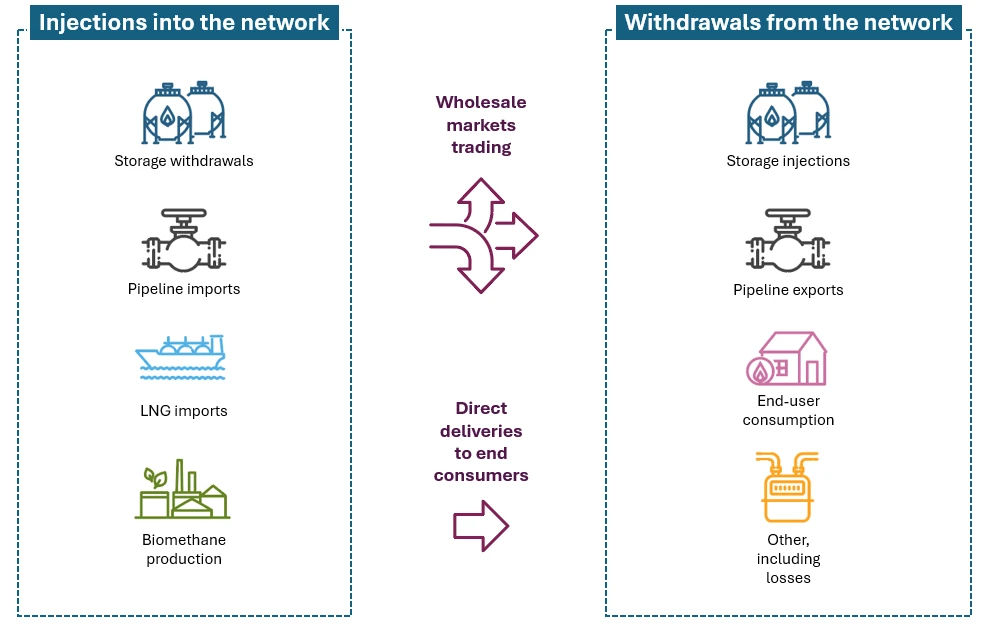
The PEG (‘Point d’Echange Gaz’), the virtual hub of the Trading Region France (TRF)
The PEG is the virtual gas trading point of the Trading Region France, the French market area resulting from the merger of the PEG Nord and Trading Region South zones on 1 November 2018. The PEG enables wholesale market participants to trade natural gas already present on the French network, regardless of its physical location. Participants may therefore use it to supplement their supply or, conversely, resell gas on the network.
For example, this allows a supplier committed to delivering gas to a customer located in southern France to procure gas from another participant importing it into the north of the country from Norway, without having to deal with the issue of transportation between those two points on the network.
Within the single market area, the PEG plays a crucial role in balancing participants’ positions. This means that a participant’s daily balance at the PEG must match the sum of its gas inflows and outflows (imports, withdrawals and injections into storage facilities, end-consumer deliveries, etc.) nominated on the TRF.
Wholesale market products: spot or forward
On wholesale natural gas markets, two types of products are distinguished: spot products on the one hand (e.g., products purchased for delivery on the next day or the same day) and forward products on the other (e.g., purchased for delivery during a specified future period).
Spot products
Spot products enable market participants to balance and optimize their portfolios at the PEG in the short term. They include:
- day-ahead products, for delivery on the first business day following the transaction date;
- within-day products, for same-day delivery;
- weekend products, for delivery during the first weekend following the transaction date.
In France, these products are mainly traded on exchanges.
They also include locational products, which involve gas delivery at a specified physical point on the network, as opposed to the PEG. However, these may only be traded at the initiative of transmission system operators (TSOs) for congestion management purposes.
Futures and forwards
To minimize risks linked to the spot market, gas market participants enter into gas sales or purchase contracts for delivery in the coming months, quarters, seasons or years, most often at a fixed price negotiated when the contract is concluded. When traded on exchanges, these forward contracts are referred to as futures. Forward contracts concluded over the counter, directly between two parties or through a broker, are called forwards. These are predominant in France, with most PEG forward transactions intermediated by brokers.
Forward contracts mainly involve standardized products in order to facilitate trading, for example delivery of one MWh on each gas day over the delivery period.
Because they have a longer horizon and generally correspond to the anticipated average spot prices over a given period, forward prices are usually less volatile than spot prices. They are used to define prices for end consumers: suppliers signing contracts with customers generally hedge most of the deliveries they will have to make by purchasing the necessary forward products.
Figures published by CRE
CRE regularly publishes analyses on the evolution of electricity, natural gas and CO2 wholesale markets in its annual report on the monitoring and functioning of wholesale markets.